Monday, March 2, 2015

Women's Roles

                                                Women’s Roles Overtime.
            During Europe’s post Feudal System towards the dawning of the middle Ages, the Renaissance and into the Nineteenth Century women were expected to perform diverse social roles or they would be considered evil and be put to death. It was a revolutionary time European history when many countries in Europe were taking part in the Atlantic slave trade and colonizing Asia and American territories. Social and cultural societies in Europe empowered rights for men to dominate over women and presumably weakened those of women. The challenges that women had to endure was perpetuated through Christianity’s gendered roles. Women were treated as prisoners of men. Despite their inferiority to men, women became writers, artists, merchants, nuns and some even ran the kingdom while the men were away at war. Joan of Arc a female cross dresser led her country’s army into battle and won. (Guerilla Girls 15) Their art work discretely communicated the dissatisfaction that women felt against the social roles which infringed upon their human rights.
           Joan of Arc coronation of Charles V11 in Reims Cathedral by Jean Auguste- Dominique Ingres 1854 in Paris.
       The Feudal System started to break down and capitalism crept in. Christianity through the Roman Catholic Churches kept Feudalism alive by pacifying its patrons with myths and spiritualism. Highly respected it had great influence over the feudal system but the ideologies of the Christianity teaching was mostly responsible for creating gendered system roles, it viewed women as the downfall of men. It perceived that women caused men to sin as taught in the Adam and Eve story in the Bible. The church excluded women in most of its hierarchy positions, such as priesthood, bishops and so forth. Female members of medieval clergy were almost exclusively nuns, while the highest status they could achieve was the position of an abbess or superior of the abbey or monastery. Women’s images began to change temporarily after the Blessed Virgin Mary concept emerged. The church conceptualized women as witches. Many were killed in mass numbers for that reason. Marriages were not based solely on love, it was arranged by families. A young girl was expected to be married by age 15. Husbands were chosen by her intermediate family. The rich upper class women were wanted for their dowry. Lower class family’s intention for their daughter’s marriage was that they will have one less mouth to feed. Many became nuns to avoid getting married. Art was very important to the church. (Gorilla Girls-19). Great Cathedrals presented bible stories and doctrines to the illiterate through artwork. The impression for many was that Cathedrals were the best that was ever erected.
            The Renaissance period men continued to dominate women lives, taking away their property rights. Christine De. Pisan stood up for women’s rights by denouncing an author who wrote scathingly about women roles in marriages. She believed that men owed their very existence to women. (Chadwick 36) While art history focused predominantly on males and the economics in the art market favored them. Many of Italy’s artists came from the social class. There were many restrictions placed on artist. Only male artist were expected to know how to paint nude portraits of men and women. The required trainings for an upcoming male artist were to do an apprenticeship, then join a guild and set up their own anatalier. Art teachers were predominantly males. For female artist to get recognition running or working in the art businesses owned by her male family members or their husbands was the only way. This allowed many women to create not only paintings but sculpting, writing and needlework. The Bayeux Tapestry of 1086 by Aelfgyva and the Cleric was an example of this marvelous work. Bologna France was also a gateway for women to succeed in their craft. It became more tolerant of female artist such Lavinia Fontana and provided unique opportunities for women. The University of Bologna was one of the first that allowed women to study there.   
                                                              University of Bologna. First to open up for women studies.
            By the 19th century women’s labor was necessary part of building colonial America. Although men played a central role, women were beginning to enjoy rights and privileges denied to them in Europe. (Chad 205) male artist were mostly interested in painting nude female artist, mistresses and prostitutes, while women fight for equality continued. The decade beginning in 1848 in the United States was a prolific period which started with the woman's rights convention in Seneca Falls, New York. Animals and women paintings became very dominant because during that time animal and women rights were being debated. Rosa Bonheur specialty was to paint horses, bulls and cows.  Her paintings depict a twofold explanation of animal and women abuse by males. As in the portrait of the horse fair, the horses get accentuated and the men are in the background. Men forced the horses to work and placed restrictions on them, instead the horses appeared to want to break free just like women. The invention of the camera introduced a fast paced way for taking photos. Some artist used it to their advantage while others saw it as a threat to painting portraits.(GG 47)  For women like Lilly Spencer the mother of  thirteen children who supported her family through her paintings. She was the daughter of parents who believed in rights for women and who encouraged her to pursue an education.  Her husband took most of the responsibility for care of the house, freeing Spencer to paint. It was in this time period female artists were permitted to study and draw still live subjects. Edmonia Lewis went to Rome to sculpture and came back to the United States to display her art to the public alongside other male artist.  


Image result for lilly martin spencer paintingsLilly Spencer's, "We must Fade."

                                                                                      19TH CENTURY CAMERA
                                                                                                                                                    http://en.wikipedia.org/wiki/History_of_the_camera                  
Artwork by Edmonia Lewis, NIGHT (TWO SLEEPING INFANTS)

Chadwick, Whitney. Women Art and Society 4th Edit. Copyright1990,1996,2002 and 2007. Published Thames & Hudson Inc.
The Gorilla Girls Bedside Companion. Published by the Penguin Group. 1998


Women's Roles

The roles that were expected of women in the middle Ages were not surprisingly based off labor. Of course this is nothing new considering the fact the women did not have the same rights as men and “our knowledge about the daily lives and customs of women in the Middle Ages owes much to representations emphasizing their labor, as in the thirteenth-century illumination of woman milking a cow” (Chadwick,43). But even around this time woman were not the only ones who revolved around work, men also were organized around work. During the Middle Ages “females were thought to be morally inferior and incapable of reason or logic (Guerilla Girls, 23).The church played a tremendous role in what was expected of women in Europe during the Middle Ages as well considering the fact that it reinforced class distinction in society. During this period  “women’s social roles remained circumscribed by a Christian ethnic that stressed obedience and chastity, by the demands of maternal and domestic responsibility and by the feudal legal system organized around the control of property” (Chadwick, 44). The roles women played in society during the middle Ages was heavily influenced by whether or not they were born into nobility. This era truly expected what we may view today as the unexpected considering it was believed that “a woman must not be a learner, listening quietly and with due submission, nor must a woman domineer over a man; she should be quiet” and this is something that is expected from woman for quite some time in history (Chadwick, 45). Although Feudalism impacted the lives of women as men it did not necessary take all of women legal rights, status and economic power considering women often managed large estates while there men were at war. Yet the status of women started to decline and many women were encouraged to take up religious beliefs.
Letty Pogrebin's oppression quote 
As the middle ages transitioned into the Renaissance period the culture hit a full 360, considering women were given more freedom when it came to expressing themselves through art. Of course there were still limitations for women but this was a big step for women although they were still considered the property of their husbands and fathers. During the Renaissance period it was not any easier being a women versus the middle Ages, especially when women were not free to divorce when they wanted and women even married the men that raped them to save her reputation. During this time outside the convent walls “women were barred from participating in the governmental patronage that created the public face of Renaissance Italy, and they played part in the guild commissions” (Chadwick, 67) So even in this period the Catholic churches played a huge role in the lives of women. There have been debates on whether education was a good thing for girls “ but a literate wife was becoming essential to the mercantile families that formed the new Florentine middle class and women’s roles in general economic life would become more circumscribed” so women became more essential to society as a whole (Chadwick, 67). In 1340 there was emendation of guild regulation which reaffirmed women right to full privileges and duty in the guild. Because of this “Women’s relationship to the guilds became inseparable from their broader social role-a role which was being radically transformed by the city’s wealth and political power” (Chadwick, 69). During this time female’s artist were truly unrecognized not only because of the fact that men dominated the art world but because women did not receive commission for their work and in some cases they signed with men signatures. 
The “women artist in Bologna benefited from the civic and ecclesiastical patronage that accompanied the naming of the Emilian region around Bologna as a papal state in 1512” and the work of these women were extremely exceptional, which paved the way for female artist during the Renaissance period. Yet due to citizens outside of Bologna who did agree with women having the opportunity to express their art, women were force to choose between marriage and learning. It was not “until the sixteenth century did a few women managed to turn the new Renaissance emphasis on virtue and gentility into positive attributes for the woman artist” which paved a way for artist such as Maria Robusti, daughter of Jacopo Tintoretto. Tintoretto taught his daughter everything she knew and with this knowledge she became one of the greatest, given great opportunities to work for king of Spain and Emperor of Austria but her father refused to let her go. Robusti was then forced into marriage and died during childbirth and after Tintoretto’s lost his work was believed to have declined. Yet many believed that it was his daughter who was creating the art and signing it off as him. Women such as Sofonisba Anguissola, Maria Robusti, and Artemisia Gentileschi truly made a difference in this period for women which later opened new doors.
Maria Robusti "Self- portrait" 
The Nineteenth Century was the era that truly made a difference for women for the fact that “Nineteenth Century reform movements are part of the growing middle-class response to widespread social and economic changes following industrial revolution” (Chadwic, 175).  During the Nineteenth Century is where revolution really started to develop for women but of course there was still battles women faced. This era was the time where “novels, plays, painting, sculptures and popular prints contributed to forgoing a coherent middle-class identity out of the diverse incomes, occupations and values that made up the class a reality” (Chadwick, 175).  Although some of these restrictions were loosened, women still faced obstacles trying to obtain art training on the same level as males. It came to a point where women played the roles of men in the sense that they were worked to support their families because middle-class males failed to earn incomes that can support their families. Part of the reason for this was the casualties of the Civil War that drained men. Women were “caught between a social ideology that prohibited the individual competition and public visibility necessary for success in the arts  and educational and social reform movements made the nineteenth century the greatest period of female social progress history” (Chadwick,177). Women really started to rebel especially when it came to art it was as if they were breaking all the rules. The Nineteenth Century became a revolutionary period for women as “qualities that defined an artist-independence, self-reliance and competitiveness belonged to the male sphere of influence and action  yet some women adopted these traits turning their backs against amateur artistic compliments , rejected flower painting in water color historical compositions in oil” (Chadwick, 177). Women such as a Bonheur and Elizabeth Thompson were great examples of artist “who did not paint like women”. This was just the beginning considering while Victoria was in power the status of women changed dramatically, “in 1837 married women had few legal rights, the n come the divorce act of 1857 which liberalized divorce for women, women property act of 1870 which enabled women to retain their earnings and Matrimonial cause act of 1884 legal protection for women outside or marriage” (Chadwick, 177). Specialized schools of art were also created in Britain for women that created a wide range of opportunities for women and because of this when woman applied to Royal Academy they used this as an issue not to let females in until Herford applied using only her initials and was admitted which lead to five other female students being permitted. The Nineteenth Century truly revolutionized the way of living for women.
Elizabeth Thompson "The Roll Call"
Work Citied:
 Girls, Guerrila. "The Middle Ages, The Renaissance, and The 19th Century." The Guerrilla Girls' Bedside Companion to the History of Western Art. New York: Penguin, 1998. Print.
Chadwick, Whitney. Women, Art, and Society. London: Thames & Hudson, 2007. Print.

Middle Ages to the Renaissance


Jan van Eyck "The Arnolfini Portrait" 1434 
As seen in this photo, women were good 
at one thing, bearing children and
 expanding the family.

  Throughout history and even today, women have been fighting for equal rights and we have made a significant progression since the Middle Ages. In the Middle Ages, gender inequality was a major inconvenience for women. Women were overwhelmed with expectations and did not receive recognition for their efforts. Women were expected to complete household chores such as, cleaning, cooking, baking bread, sewing, weaving, spinning, and serving their husbands. Women did not have a right to choose their own husband or even gain an education if they wanted. During this time period, men had total control and authority over women. In the Guerrilla Girls, it says, “A woman was required to be faithful to her husband, and adultery could be punished by flogging or being buried alive. Husbands were allowed to commit adultery, unless it was with another man’s wife” (Guerrilla girls, 22). This represented lack of value for a marriage between two individuals. For a man to commit such an unjust act while married to woman and receive absolutely no consequence is absurd. As a woman, if adultery was committed, she was buried alive; the difference in punishment is incomparable. As far as education was concerned, “Education was thought to interfere with a woman’s ability to be a good wife and mother. Almost no women were taught to read and write” (Guerrilla girls, 22). It is upsetting to snatch a woman of her rights to educate herself merely due to selfishness. It was dangerous for women to be educated because it was a threat to men, they were intimidated by such a thought. Women were supposed to be the best mother and wife possible and gaining knowledge was obviously asking for too much, it might’ve even become a substitution for time.

        
This is the epitome of the message female artists
were trying to get across as far as their rights were
concerned. They were not given acknowledgment
 for any other talents because they were restricted to
 taking care of the family. 
    For any years, women artists were oppressed until some courageous women decided to make noise. Christine de Pizan was “the first woman known to have made her living as a writer in the Middle Ages” (Guerrilla girls, 23). Christine’s purpose was to emphasize the strong character female portray in comparison to the same things that men were capable of. She was the first feminist to educate others on how women can have a positive influence upon society. Women began to take a stand through writing and their paintings displaying women in another light than in the shadows of men. Artemisia Gentileschi “A woman like that” She made her own rules, she challenged male painters. As you can see in this short clip, A woman like that, she stood up for her talents and represented for all women artists.   Being as though women had no voice women artist made statements with their works of art painting the woman just as capable and intellectual as her counterpart. Another successful female artist by the name of Mary Cassatt during the 18th Century became well known for her depictions of women " actively at work, at women's work, not as passive models or objects of the male gaze" (Guerrilla girls, 56). Women artists wanted to stray away from the idea of male artists and the male gaze. They wanted to paint women and portray them as they view themselves, not as an object but as a human being. “It is in the cultural ideology that supported women’s exclusion from the arts of painting and sculpture that we find the roots of the subsequent shift of woman’s role in visual culture from one of production to one of being represented” (Chadwick, 67). Society followed the rules and allowed male artists to brainwash the audience into liking exactly what they expect them to be attracted to, and that was the issue.

            From the Middle Ages into the era of Renaissance (rebirth), women began to gain more freedom. Women became nuns, which led them to stay in convents and make decisions for themselves since they did not have a male dominator telling them what to do. “Their careers were made possible by birth into artist families and the training that accompanied it, or into the upper class where the spread of Renaissance ideas about the desirability of education opened new possibilities for women” (Chadwick, 76). The city of Bologna flaunted women artists more than any other city in Italy. There was a school for female artists and many pursued further education in Philosophy and Law. In comparison to the Middle Ages, the Renaissance was a period with greater equalities for women. For example, in the novel, it states, “Women could divorce her husband only if she could prove him impotent” (Guerrilla girls, 32). They were given a right over their marriage rather than being forced to live with a man that cheated on her. They were even given the right to teach in a university in the city of Bologna. With a few adjustments in laws and regulations, it was evident that women were granted more freedom which was beneficial to the rest of society long term. In this link, Women Portraits Portraits of Women during the Renaissance, you can examine the attire and differences in women during this time period as opposed to the Middle Ages. These portraits depicted the image women embraced.

This is a painting of women taking revenge for all the restrictions put upon them. 


Work Cited:

Girls, Guerrilla. "The Middle Ages, The Renaissance, and The 19th Century." The Guerrilla Girls' Bedside Companion to the History of Western Art. New York: Penguin, 1998. 18+. Print.

Chadwick, Whitney. Women, Art, and Society. London: Thames & Hudson, 2007. Print.

Women's Roles during the Middle Ages and the Renaissance

The battle between men and women is one that has gone back to the beginning of time. Men have always been considered to be superior to women. Women have always be taught to live in the shadow of men. During the Middle Ages this was not much different. There was a feudalistic economy in Europe during the Middle Ages. Social class played a big role in the life of the people especially the women.
Women of the upper-class were had more in common with men of the same class. Lower-class women on the other hand were at a greater disadvantage. “The Church’s hierarchical organization reinforced the class distinctions on society”(Chadwick p.44). Women in this period didn’t have much of a role in society. They were required to be in the home and do the labors of the household. They didn’t work in jobs where they could get paid so they were financially dependent on the men in their lives whether it be father, husband, etc.
Women didn’t have much if any accesses to things in society unless they were of the upper-class. Women had to abide by certain rules and do as they were told. Some of the things women couldn't do included the following:

  • Education was thought to interfere with a women’s ability to be a good wife and mother. Almost no women were taught to read and write.
  • Almost all women work in some family business, but the fruits of their labors belonged to the men-their fathers, husbands, or brothers.
  • A women had to obey her husband, and he could beat her if she didn’t.(Guerrilla Girls p.22)

A woman in the Middle Ages was not given any opportunity to be able to grow in society. They just had to “play their roles”. Their roles was to be caregivers and to be faithful to her husband and be all about the family. Some times women were allowed to work outside the home. This was only possible if they worked in a family business. All the credit of their work and monetary compensation they may have gotten from their work belongs to the men of their family. They weren't entitled to anything. This link describes the life of a women and the difficulties women
faced during the Middle Ages : http://www.historylearningsite.co.uk/medieval_women.htm
“Our knowledge about the daily lives and customs of women in the Middle Ages owes much to representation emphasizing their labor, as in a thirteenth-century manuscript illumination of a women milking a cow.”(Chadwick p.43)

                                Illustration in a Bodleian Library manuscript, Ms 764, .4IV.
              (This picture depicts the role women had in society in the Middle Ages as labors)

Now we enter into the Renaissance period where things begin to change for women a little. During this time period women were still not welcomed in the art world with open arms. The guilds didn’t allow women to join. There was a way around this though. “One of the few ways a women could work as an artist was to be born into a family of artist that needed assistance in the family workshop” (Guerrilla Girls p.29).
The rights women had during the Renaissance Period changed compared to the Middle Ages,

  • She could divorce her husband only if she could prove him impotent.
  • She could salvage her reputation by marrying any man who raped her.
  • She could attend or teach in a university if she moved to Bologna. (Guerrilla Girls p.32).

During the Middle Ages women had no rights or say in what went on in there lives. During the Renaissance Period that changed a little. Now women were allowed to have an education. She was allowed to end her life with a man if she didn’t see him being a fit husband. She could also salvage her name if a crime like rape was ever committed against her. During this time women had a little more freedom but they were still controlled by the men in their lives. The following links describes the gender roles of a women during the renaissance in more details:
http://www2.cedarcrest.edu/academic/eng/lfletcher/shrew/acloud.htm
               Artemisia Geentileschi, Sussana and the Elders, 1610

Artemisia worked in her fathers atelier. One of the men who worked in her fathers studio forced her into a room and raped her. Scared frightened and hurt Artemisia wanted to kill him with a knife. To calm her down he had promised to marry her. During this time marrying the man who raped you cleared your reputation and nullified the crime. You can notice the difference in paintings from the Middle Ages to the Renaissance. The Middle Ages painting portrayed what women were supposed to be doing which was labor work. In this painting Artemisia goes against what a male painter would normally do and goes from a female perspective. She paints this picture making the women look scared and vulnerable rather then making her seductive or flirty. Instead she shows that the women wasn't asking to be raped. Unlike a man who would depict the photo as she asked for it.

 Judith Slaying Holofernes, Artemisia Gentileschi 1620

“A women artist does not present herself as a gentlewomen, but as the act of painting itself” (Chadwick p.113). Artemisia didn’t paint pictures to portray women as soft innocent people like most men have made them out to be. Instead she paints pictures that may be considered vivid and horrifying to show that women are strong and can be their own hero.
Throughout the Middle Ages and the Renaissance you can see a lot of change in women lives and works. They still are controlled by the men but now they are able to work, get and education and paint in their own ways.

Sunday, March 1, 2015

Post 2: Women's roles from Middle Ages to 19th century

Women have long struggled to be equals to men since the beginning. Let’s start with the Middle ages. The middle ages are the 11th and 12th centuries. The economy was based on feudalism and social classes clearly ran the society. It was already hard to be a woman because of discrimination, but the least advantaged was to be a woman of a lower social class. Education was extremely hard to attain as a woman. “Education was thought to interfere with a woman’s ability to be a good wife and mother. Almost no women were taught to read and write” (Guerrilla Girls, pg. 22). All women were expected to be wives, mothers, and take care of the house; essentially to be childbearing objects that were nice to look at and own. The following website accurately describes what being a medieval woman included: http://www.historylearningsite.co.uk/medieval_women.htm

One important piece of art is The Bayeux Tapestry. This was created in 1086 and was embroidered on wool. The main focus of the piece is power of men and their exploits. However, the origin is unclear.


"The Bayeux Tapestry" 1086


Moving into the renaissance era, roles for women were slowly starting to change. The renaissance is in the 1500s/14th century. Mercantilism was starting to overtake feudalism. Women were excluded from guilds because only men were taken seriously enough to participate. “One of  the few ways a woman could work as an artist was to be born into a family of artists that needed assistance in the family workshop” (Guerrilla Girls, pg. 29).

The Victorian era is when women had more roles than being a wife or mother. More women artists emerged from this time period because the fight to be heard was growing stronger. When transitioning to the 19th century, women’s labor was needed in colonial America. There was a social reform for “domestic feminism”. Needlework and painting grew more common along textile weaving due to the industrial revolution. More and more women’s art was emerging along with Impressionism.

One important renaissance artist is Sofonisba Anguissola. She was born in 1532 and died in 1625. She painted many self-portraits. one thing that makes her stand out is that she worked in courts for the kings and queens. Her father, Amilicare, was a painter as well who wrote to Michelangelo about her work. Her piece, Self Portrait in 1561 addresses roles of women in society. The picture is of her painting a portrait of another women. She already made a statement by being providing for herself as a woman artist, but then painted herself which was a statement in itself. Another statement she made was by in the painting it was her painting another woman.


"Self Portrait" Anguissola, 1561.


Another noteworthy woman is Judith Leyster. She was born 1609 and died in 1660. By 1633 she was a member of painter’s guild which is a big deal because guilds often excluded women. She had 3 male students but unfortunately died unknown with much of her work having been credited to her mentor. Her painting reflected roles of her time because her work was often of domestic spaces or women by candlelight. This accurately depicted women in that time period because women are often meant to stay inside and not be out and about. If she was jailed in a domestic setting then that would be all she could really paint.

One female artist that stood out to me in the Victorian era is Rosa Bonheur. She was born in 1822 and died in 1899. Rosa was quite the exception for her time period. She came from a family of political idealists and her father believed in educating women. She cross dressed with her partners in order to travel because women for limited on the traveling they could do. She had a life partner, Nathalie Micas so she never married. Her painting style included those of animals and their need for freedom which often strongly resembled what women were having to fight for as well. Another accomplishment she achieved was being prized for one of her paintings. Her award winning painting is “Plowing in the Nivernais” in 1848. For more information on this painting visit: http://www.musee-orsay.fr/en/collections/works-in-focus/painting/commentaire_id/ploughing-in-nevers-2040.html?cHash=60f905d6af


"Plowing in the Nivernais" Rosa Bonheur, 1848. 


Last, but certainly not least, a powerful woman artist is Berthe Morisot. She was directly involved with the impressionism era in Paris, France during the 19th century. She was the first woman to show in the French salon of Paris. This was a big accomplishment because the salons were mainly left to men because women were not thought to be as intellectual. Morisot was born into a wealthy family so this gave her a leg up into become an iconic painter. She was also the first women to join the group of impressionists along with mary Cassat, Edouard Manet, etc. Morisot’s paintings often depicted a happy family life, children with their mother, or her own sister. Morisot poured a lot of effort and work to start a huge movement along with other notable artists.

The Progression of Art

As the flow of time continues to tick its life away, advancements in society begin to occur. Yet when analyzing the centuries beginning with the middle ages to the 19th century, conditions for females went from strict slowly decreasing little by little, still having a wave of rules and restrictions that they must follow. 
 
We start with the middle ages⎼ the economy was a strict feudal system, where everyone was born into a specific social class and religion not only satisfied the majority of the lower class, but having a greater impact on women. It was easy for a man to divorce his wife or cheat on her, but the female was not allowed to as her reputation would be affected and legal repercussions would occur. Women were either a stay at home wife, or became nuns, spreading religious views and beliefs. Whitney Chadwick, author of Women, Art, and Society, states “the presence of well endowed convents during the [11th and 12th] centuries encouraged large numbers of women to take up religious lives… there is considerable evidence of women’s participation in [spiritual revival],” (53).
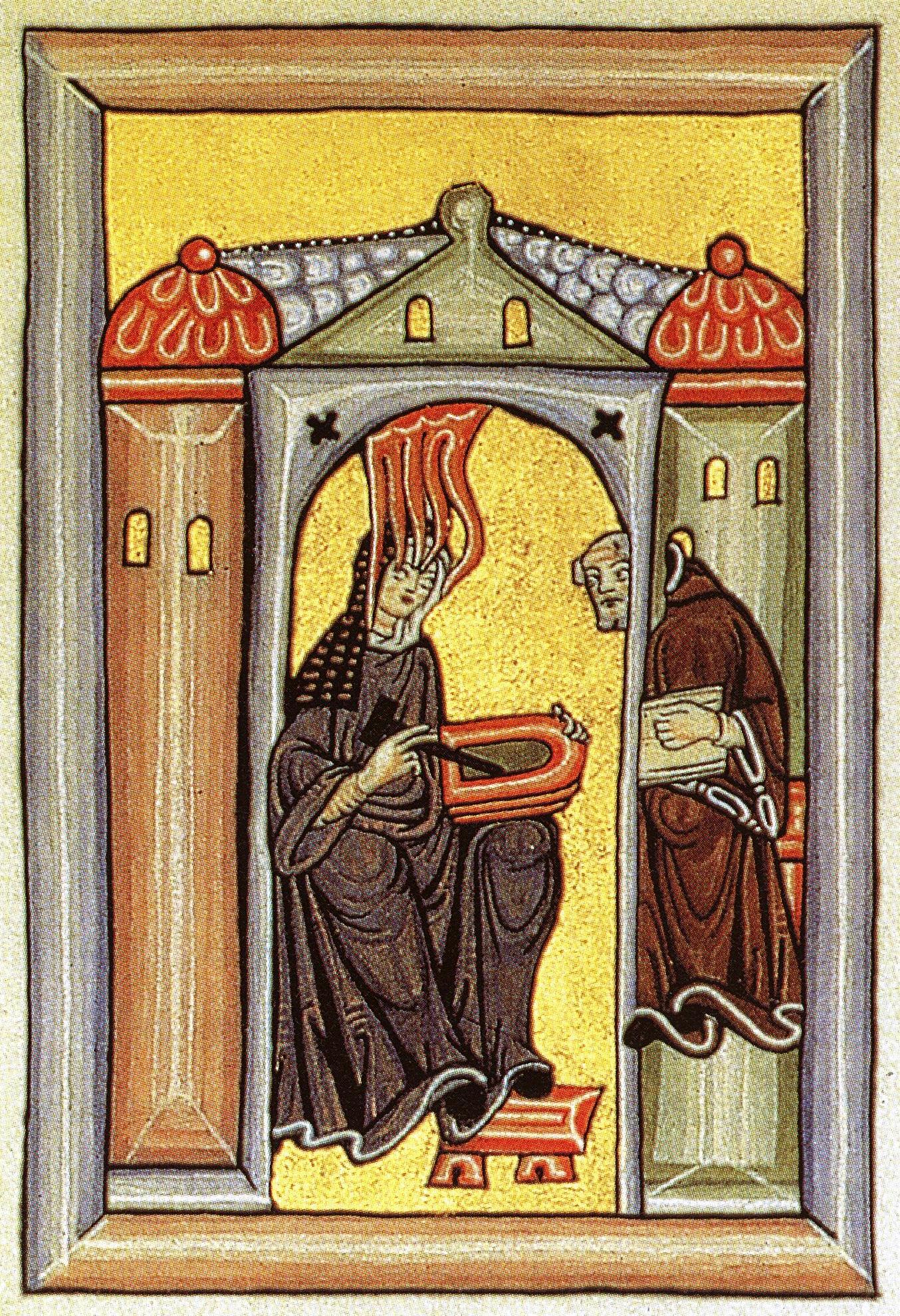
Hildegard of Bingen, Scivias, 1142 
Some females experienced visions from Christ himself and painted what they saw such as Hildegard of Bingen in
. Aside from the religious aspect, females too were writers and clearly artists. An example would be the The Bayeux Tapestry, a long banner with stitching of daily life. Women were not shown in the actual banner, yet it had lots of embroidery revealing the power of the man. “[Scholars don’t know when it was created], but they all agree that it was embroidered by women,” said the Guerrilla Girls’ in Bedside Companion to the History of Western Art. In other words, women had no rights, must obey the man, have no education due to their social status and role in society, but were beginning to reveal their artistic talent. 
Tick tock⎼ Renaissance time. Still, women had no rights and must obey their husband. The most important role was being a housewife and taking care of the kids, cook, help your husband run business when he is away, or if you weren’t married, you lived on your own or joined a church. Women became artists if they were born into it regarding their social class or married a husband who was one and weren’t allowed to join guilds. “...Women were barred from participating in governmental patronage… and they played no part in guild commissions,” (Chadwick 67). You can get become educated now, but it would have to be done through the Church or through an instructor, unfortunately you would need money for that, which few women had.
Artemisia Gentileschi, Judith with Her Maidservant, 1618
During this time period is when the art of sculpting started to grow such as artist Properzia de Rossi who lived on her own. “[Rossi] is the only known Renaissance woman to have sculpted in marble. She began by carving miniatures on cherry stones, but soon went after bigger fruit,” (Guerrilla Girls 31). Her talent caused her great recognition, momentarily, as her reputation became salvaged her work decreased with it. Women artists tried to signify their strength by recreating pieces of art with their own interpretation such as in Artemisia Gentileschi’s
Judith with Her Maidservant, where the two females are drawn with strength and courage versus her father Orazio Gentileschi’s version. They also tried to prove their equality such as in Elisabetta Sirani’s Portia Wounding Her Thigh, where Portia impales a knife on her leg to prove that she is strong like her husband Brutus. As females artistry began to grow, so did paintings of self portraits. These portraits included both genders, male and female, like in Lucias Anguissola’s Portrait of Pietro Maria, 1560.

Elisabeth Sirani, Portia Wounding Her Thigh, 1664

Tick Tock- 18th and 19th century. 18th century art became about domestic scenes and still life art such as painting fruits on table, flowers, etc. Women painted about insects and bugs so clearly that it attributed to future scientific research on these critters such as Anna Maria Sybilla Merian in her books and who was interested in animals and nature. Females roles in society became a little less strict, as women are able to work their way up to become rich, sneak their way into one of the best academies for school (English Royal Academy), or even become teachers to future art students. Still, despite these achievements, women were prostitutes or worked very long hours sewing clothes, doing needlework, etc. Men still were in control, for instance they controlled the wages/earnings women brought home and if you didn’t like a marriage, only choice was to flee. In 19th century, the invention of the camera helped create a new form of art- photography which they could not be rejected from. As animal paintings grew, a symbol was formed- they symbolized freedom/fighting for it. Reason so was due to the increase in fighting for women’s rights, “images of animals frequently symbolized the vices and virtues of women. Constantly exhorted to rise above their ‘animal’ natures, [they] were pursued by animals exemplars,” Chadwick wrote (192). Women also continued to tell stories through their art like in Harriet Powers Pictorial Quilt which had many sewn images of her memories from being a slave.

Harriet Powers, Pictorial Quilt, 1895


In the end, you can see a dramatic change in women and their rights. Being born into this ruling that they must obey, trapped in chains sealed by society and their husbands, caused them to fight for change. From the typical housewife to receiving education, contributing to scientific research, fighting for their rights they never had, women were fed up and it can be revealed through the progression of their art. 


The Bayeux Tapestry's each broken up into different parts as the original is too long.

Since the Renaissance was a very impactful time period, here is more information regarding 
women during this period.

Works Cited
Chadwick, Whitney. Women, Art, and Society. New York, N.Y.: Thames and Hudson,
1990. Print.
The Guerrilla Girls' Bedside Companion to the History of Western Art. New York: 
Penguin, 1998. Print.

From Damsels to Modern Women

The Middle Ages, when thinking about the middle Ages I think of dungeons and dragons. It was a time where women were portrayed as nothing but damsels in distress. Education was ran by the church, if someone was educated it was because they involve with the church in some way or they were a man. According to the Guerrilla Girls, “Education was thought to interfere with a woman’s ability to be a good wife and mother. Almost no women were taught to read and write”(Guerrilla Girls, 22).  Women were considered as vessel of nothingness and all they could do is bear children and take care of them. Women were property of their husbands and fathers. “A woman had to obey her husband, and he could beat her if she didn't” (Guerrilla Girls 22). The only way for them to escape this captivity from the men in their life was to either become a prostitute or join a convent and became a nun. In the Guerrilla Girls it also states “a woman was required to be faithful to her husband and adultery could be punished by flogging or being buried alive. Husbands were allowed to commit adultery, unless it was with another man’s wife”(Guerrilla Girls, 22).  If you weren't a nun there were many rules against what you could or couldn't do. Although once they join the convent there were still things that they couldn't do. In Women, Art, and Society, Whitney Chadwick quotes St Paul; “a woman must be a leaner, listening quietly and with due submission do not permit a woman to be a teacher, nor a woman domineer over a man; she should be quiet “(Chadwick 45).

Christine De Pizan in her study, From The City Of Ladies
Hildegard von Bingen is a perfect example of one of the many the women St Paul believed should have stayed quiet.  Bingen was a nun who wrote about the corruption that priest were committing. Another women that St Paul would have probably hated is Christine De Pizan .She was a writer who broke the rules. She did not censor her work and by censor I mean she wrote about men who belittled women .She wrote about all the injustices that women were facing during these times. Women artist during these times used their own experiences and observations to create artwork.

During the Renaissance, academies for artist and guilds were booming.  If you were a respected artist you were either in a guild or attended one of these academies. As usual women were banned from these artistic establishments. In order for women to even take up art they were either born into a family were their fathers were artist or they married an artist. During the Renaissance, women could salvage their reputation by marrying any man who raped her, and she could attend or teach in a university if she moved to Bologna (Guerrilla Girls 32). There were many great women artists during the renaissance which included Sofonisba Anguissola, Elisabetta Sirani and Artemisia Gentileschi. Elisabetta Sirani’s art was so great that she was accused of forging her signature on what the people believed to be her father’s paintings. According to Guerrilla Girls in order for her to prove to people that those paintings were hers, she started painting in public. Later in life she opened up a school for women artists. She used her painting to convey political and social messages. In her painting of "Portia" , according to Chadwick “Portia has proven herself virtuous and worthy of political trust by separating herself from the rest of her sex”( Chadwick 101).
Portia Wounding her thigh, Elisabetta Sirani 1664.
Artemisia Gentileschi had it rough; she was raped by one of her father’s workers. Naturally the man who raped her asked for her hand in marriage so he could “save” her reputation.  Gentileschi used her experience  and anger to paint about women being heroes. Artemisia's life was truly interesting, this article should show you why she was the most interesting person during the renaissance. Her work inspired a lot of women.Most women of this era used their artistic skills to paint their experience in this patriarchal world. Chadwick summarized this era for women perfectly by stating “Woman artist does not present herself as a gentlewoman, but as the act of the painting itself.”(Chadwick 113).
Judith Slaying Holofernes, Artemisia Gentileschi 1620.
 During the 17th and 18th century,  art depicted domestic scenes and scientific works. In those scenes women were either reading by candle light or doing some kind of sewing. If you were a women in the 17th and 18th century you were sent at the tender age of 12 to work long hours at textile and garment trades.  If you showed some kind of talent you were considered to be a witch. If you were rich you were displayed to world that you were ready to be courted by having debutante balls.Women were stating to get tired of being put on displayed like they were just objects. Although made in the 19th century, Lilly Martin Spencer's painting, We both Must Fade  was a perfect example of how tired these women were starting to feel.
The Horse Fair, Rosa Bonheur 1853. 
 By the 19th century women were fighting for their freedom and rights. In their art work they incorporated that urge for freedom.  Important women artist during this century included Rosa Bonheur ,Edomonia Lewis , Harriet Powers and many more. Their art work had a lot of symbolism within it.  Most of these paintings had hints of women wanting social reform. In Rosa Bonheur’s paintings she used her love for animals to portray women’s feelings of captivity and need for freedom and respect. Women were no longer caring about what men wanted they made sure their feelings were out there. They used their art work to speak for them. Their paintings and art work were controversial but it was the only way to get their point across. Chadwick states “By the 1900, feminist  were demanding not just voting rights for women but their right to higher education and the right to earn an income and the modern women had appeared”(Chadwick 251). Women continued to fight for what they believed was right. They were no longer this damsels in distress who was scared to fight for what they wanted. They evolved into this woman who knew exactly what she wanted and demanded it, the modern woman!


                                                                    Works Cited
Chadwick, Whitney. Women, Art, and Society. 4th ed. New York, N.Y.: Thames and Hudson, 1990. Print.
The Guerrilla Girls' Bedside Companion to the History of Western Art. New York: Penguin, 1998. Print.