Showing posts with label Juan Rios. Show all posts

Thursday, April 16, 2015

Brooklyn, we go hard

Brooklyn Museum Exhibitions

        Lets begin by actually realizing how slow the Brooklyn Museums website is. By the time you try to search the archive for a possible idea or theme, it will constantly stay loading. Nevertheless, this post is not about the lag of the Brooklyn Museum's website, the artists and their objects/exhibitions that are within it! Originally, I had either between two themes I wanted to do, Feminism or Photography. The issue between those two was that there was either not enough women exhibitions, exhibitions with no title/contributor, or not enough information at all. Therefore I switched my focus to contemporary art because there are so many ideas that can fall into this category. Creativity continues to evolve, so it is a pleasure to see the abilities women have to express their thoughts. The five female artists and their exhibitions that I will discuss are: Alexis Smith, Jenny Holzer, Caitlin Cherry, Rona Pondick, and Shura Chernozatonskaya.
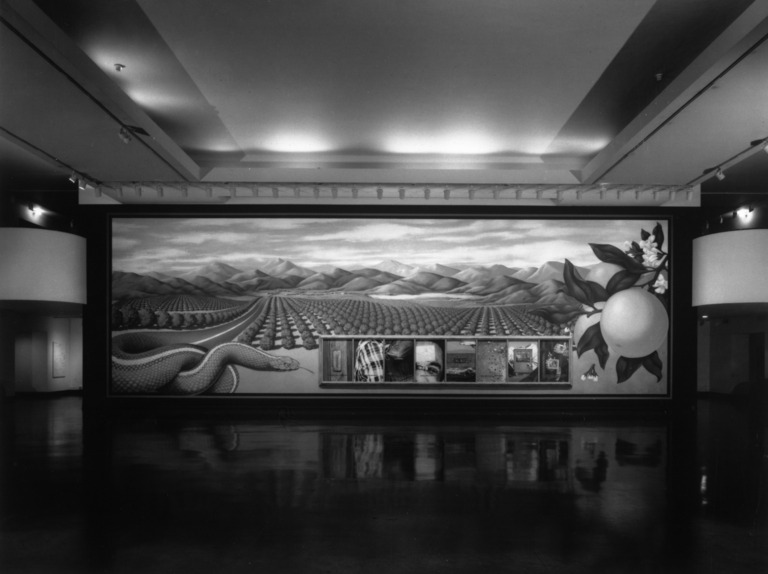

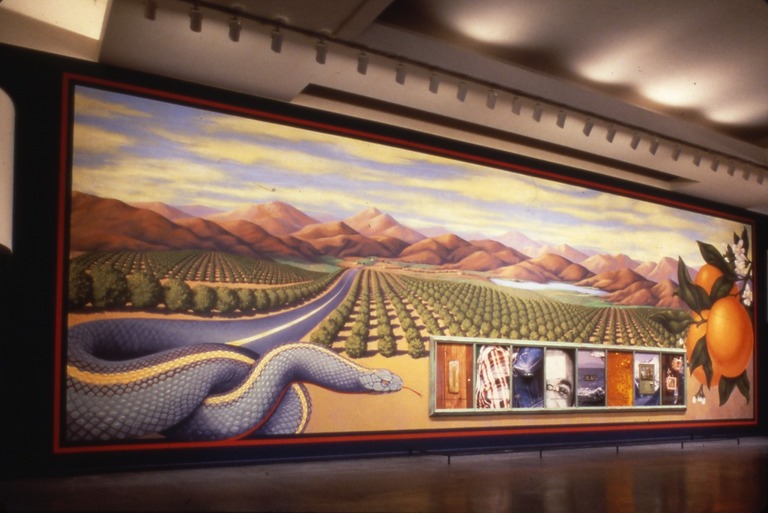
Alexis Smith, Same Old Paradise, 1987-88
        We begin with Alexis Smith, female contemporary artist whose exhibition Same Old Paradise was introduced in the Brooklyn Museum in 1987. Born in 1949, Patti Anne Smith (her real name) began her artistic life by making collages of pictures and words. She attended the  University of California in 1970 where she earned her degree of a Bachelors in Arts. Before the actual analysis is given, ill give my interpretation/what I think of it.  I love how the road transforms into a snake, I think that's creative. As for the actual purpose of it, I have no idea. The piece is simple, yet yields so much creativity through the scenery, trees, and life (possibly a huge factor). Apparently, from Brooklyn Museum website, Smith was inspired from a book called On the Road by Jack Kerouac. On the bottom right of the piece, you see eight collages that are drawn from advertisements you may see throughout your day and images from novels she has read. The website also claims to reference the Garden of Eden, or Garden of God. If you seen the photo, you can analyze the similarities the two share of the beauty of life. A 60 foot long piece that grasps your attention in an instant.
     

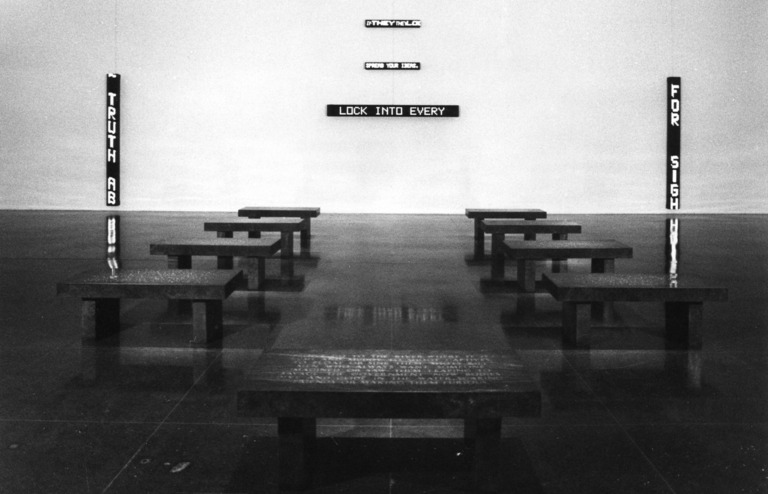
Jenny Holzer, Signs and Benches, 1988
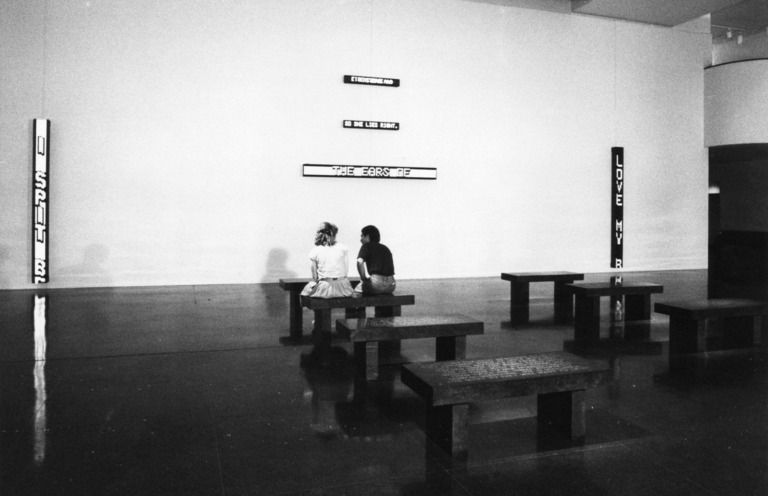
Next on the list is artist Jenny Holzer. Born in 1950, Holzer has a style of art known as conceptualism, identifying concerns or ideas using art. She attended various institutions, taking general art classes and/or earning her degrees in Duke University, University of Chicago, Ohio University, and Rhode Island School of Design. Because of this, it allowed her to develop her artistic ability through various view points. She is also known as feminist artist and currently resides in New York today. Holzer's exhibition in the Brooklyn Museum is called Signs and Benches, where electronic signs display various messages. This is one of those pieces where the if there was no wording involved, it would cause you to think deeply on what the artist is trying to convey. I've tried to make out some of the wording through the electronic signs, but I
believe the words move because it doesn't make sense (unless that's how Holzer wanted it). Nevertheless, what I made out was, "I spit...," "Love my...," "The ears of...," "Truth about...," and "Lock into every..." There are words inscribed onto the benches, but it is impossible to make out the message. Despite the unclear message, it evidently falls into her themes of sex, war, and death in this piece. This exhibition reveals creativity, showing how Holzer is keeping up with the new age of technology and incorporating it into her work while still trying to convey a message to society.


Caitlin Cherry, Hero Safe, 2013
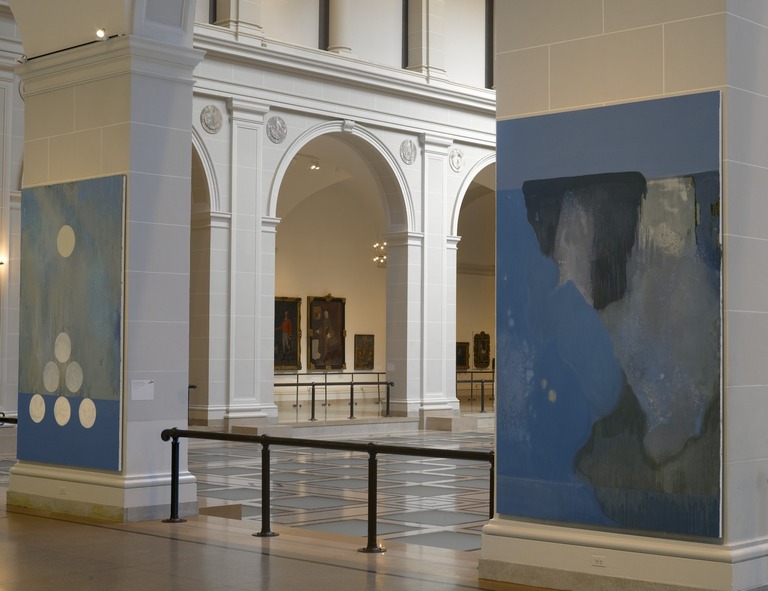
        Next on the train is artist Caitlin Cherry. Cherry was born in Chicago, Illinois, and currently resides in New York. She earned her Bachelors of Fine Arts from in Chicago and her Masters of Fine Arts from Columbia University.  Before we begin on her exhibition, I've found her website that contains her information and other works she has done. This exhibition that I am focusing on is called Hero Safe. The objects, more like weapons and tools, grasped my attention; pretty unique idea. You see a large crossbow, a catapult, and what seems to be a wheel. My initial interpretation was that she was taking art back into the past, since inventions as these are rarely, to not even used anymore. Cherry is trying to make a point to not forget where modern art was originally innovated from. From the Brooklyn Museum website, it claims that the weapons are to protect and damage her work. Focusing on themes of weaponry and art, she drew inspiration from Leonardo da Vinci. Nice exhibition that gives you a "blast from the past."

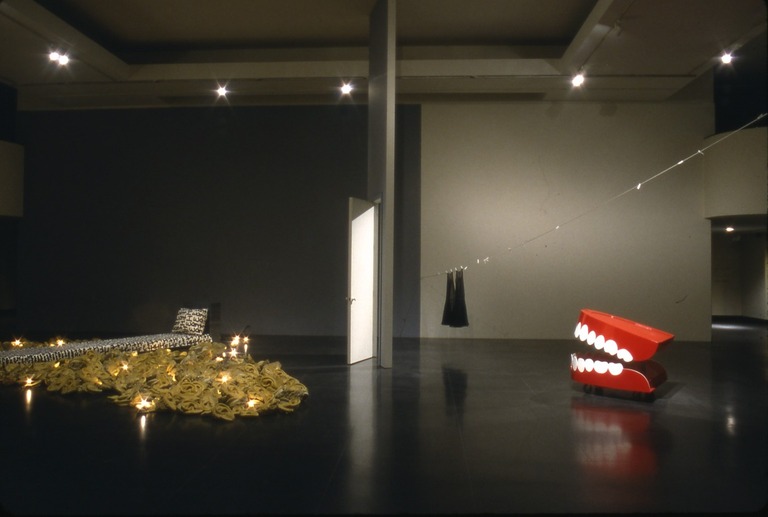
Rona Pondick, Mine, 1996-97
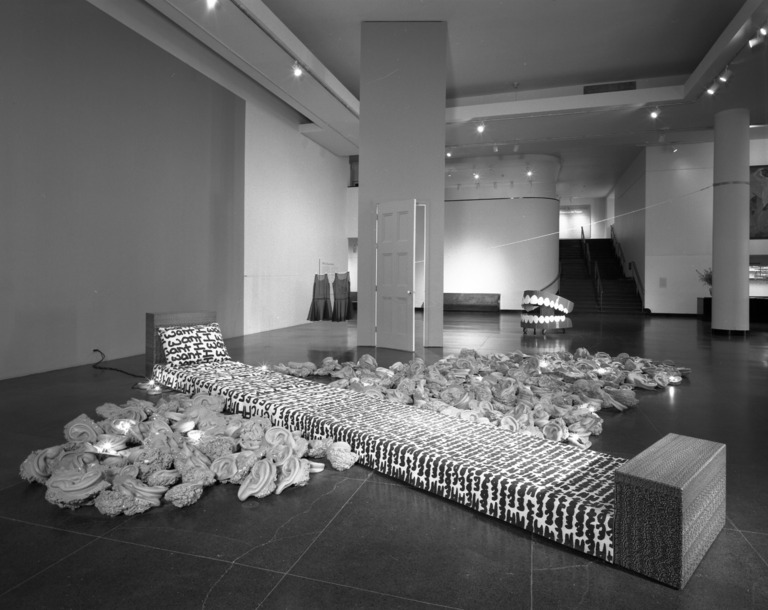
Fourth on the list is Rona Pondick. Born in Brooklyn in 1952, Pondick earned her degree from Yale University. Her art is sometimes defined as feminist art and she focuses mostly on sculptors. Also known for hybrids, she fuses human, animal, and/or plant life into her sculptors. This link will take you to her website where you can view some of her group and solo exhibitions, art work, etc. In this exhibition, originally a performance piece, a door separates two realities, outside life and inside life. Inside is supposed to be a long bed with the words "I WANT" inscribed around it and the outside is a large mouth that resembles the winding mouth toy that clatters until it dies out. From under the bed, small, soft ears will pour out and clothing will slide down through a line that the performers will wear throughout. Being a little weird and bizarre, the website states, "The mouth, like the ear, is an organ that mediates inside and out for Pondick."

Shura Chernozatonskaya, 2006
Last for the anchor, we have Shura Chernozatonskaya. Born in Russia (now I know where that last name originated from), she earned her Masters of Fine Arts in New York, 2006. Her studio is currently in Red Hook, New
York, a village community. Under the large section of Raw/Cooked in the Brooklyn Museum, the first piece (top) is located on the first floor, and the second (bottom), with many others as such, are located around the third floor. Shura was the last one simply because her art reminded me of childhood, how there are board games with various colors, yet also resembles the game dominoes. Yet also with the various colors, shapes, and flashbacks, for her piece(s) to be scattered around the museum is interesting since there isn't one specific section for it. Sort of the Mickey Mouse prints scattered around Disney Land, you have to search for them. Chernozatonskaya's other works, collections, and exhibitions can be found on her website.


Bibliography 

Chernozatonskaya, Shura. "Exhibitions: Raw/Cooked: Shura Chernozatonskaya." Brooklyn Museum: Raw/Cooked: Shura Chernozatonskaya. Brooklyn Museum. Web. 16 Apr. 2015.
[Website: http://tinyurl.com/orpcdx9]

Pondick, Rona. "Exhibitions: Mine: Rona Pondick." Brooklyn Museum: Mine: Rona Pondick. Brook. Web. 16 Apr. 2015.
[Website: http://tinyurl.com/ngurtqn]

Cherry, Caitlin. "Exhibitions: Raw/Cooked: Caitlin Cherry." Brooklyn Museum: Raw/Cooked: Caitlin Cherry. Brooklyn Museum. Web. 16 Apr. 2015.
[Website: http://tinyurl.com/noxjt4b]

Holzer, Jenny. "Exhibitions: Jenny Holzer: Signs and Benches." Brooklyn Museum: Jenny Holzer: Signs and Benches. Brooklyn Museum. Web. 16 Apr. 2015.
[Website: http://tinyurl.com/ownd3vg]

Smith, Alexis. "Exhibitions: Alexis Smith: Same Old Paradise." Brooklyn Museum: Alexis Smith: Same Old Paradise. Brooklyn Museum. Web. 16 Apr. 2015.
[Website: http://tinyurl.com/nh7xkml]

Sunday, April 12, 2015

Semester Project

One of the inspirations my cousin
used for the art piece I will bring
to class.
        Originally for my semester project, I wanted to focus on female bodybuilders. The topic would relate to bodybuilding and body image, how one views themselves and how fitness plays a role to achieve these desired looks. Unfortunately, I could not find any female artists that focused on weight training, lifting, anything pertaining to those categories, therefore that was a fail. So I had to change my topic, sort of. The same concept would be applied, but instead I will discuss the various ways females view themselves (since there are many women artists who focus on body image) and how the benefits of fitness can help change these mental and physical view points individuals have. I was going to do a video, but I decided to do a power point instead. My cousin, who graduated from Arts High School, has also decided to help me by drawing women who are fit, which allows to see the benefits of it and to bring a little work to class. I have no idea how it will turn out, but I know he using either chalk or pastels to draw it. All my research would be conducted using the Rutgers Library database search and also prior knowledge that I learned/had already.

Sunday, March 29, 2015

Mi Vida y Mi Impacto: Frida Kahlo

        During the brightest day, a shadow will be casted through the objects and individuals that people will not notice nor seem to care about. It's just a shadow, after all... Eventually when the objects and people disperse from the light, the shadow will vanish and it will be then when people become curious about its significance. This short metaphor is symbolic of Mexican artist Frida Kahlo's life between birth through marriage and death. The shadow is Frida. It hiding behind objects/people represents her hiding behind her famous artistic husband, Diego Rivera and when she passed away (shadow fading away) is when her work began getting noticed leading to her popularity.


Frida Kahlo, Self Portrait with Monkey, 1938
The leaves in the background and uses of
natural coloring relates to the
Mexican heritage.
        Born in Coyoacán, Mexico, 1907, Frida Kahlo de Rivera (de Rivera is after her marriage) was born to a father and mother of a Jewish and Spanish decent, but clearly focused only on the Spanish as noticed throughout her self portraits. Roughly around the age of 18, Frida suffered a devastating accident involving a trolly and bus that almost took her life away with a pole being impaled in her body. She survived and through the process of her recovery is when is she began drawing. Originally her art was how she viewed herself from the accident and then evolved into a more artistic view of herself. Years later, Diego Rivera, a famous artist noticed her work, motivated her artistic ability, and eventually they got married. Although they had an off and on relationship/marriage and her being bisexual, she had deep, unconditional love for him. It was right before her death in 1954 that people began noticing her work and it contributing to future feminist movement, inspirations, etc.


Frida Kahlo, My Birth, 1932
Frida's depiction of how her mother gave birth to her
        In the 20th century, at a young age, she lived during the Mexican Revolution in 1910, which probably helped made Kahlo so strong and created her own will in her art work. When her and Diego moved to the United States she lived through the time where the 19th amendment was ratified, therefore granting the right of allowing women to vote. Yes, men where still superior and women were inferior, but it gradually began to change with the Frida being one of the contributors. Take her unibrow for example: many people would consider it unfeminine, but to her, she does it to represent that she is different, that she does not follow the male gaze with their preferences. She can be defined as reckless, doing what she pleases such as going to bars, engaging in sexual relations with the opposite gender, clearly abiding to her own standards. Julio, an author who wrote in the Feminist Art Archive for the University of Washington wrote "These acts were all seen as rebellious behavior back in the early 1900's, but after analyzing these acts with modern feminist perspective we can see them as unconventional/revolutionary feminist acts of her time," (1).


Frida Kahlo, Henry Ford's Hospital,  1932
Frida Kahlo on a hospital bed with the city in the background.
        Despite Kahlo only having one form of a medium which is painting, she is highly skilled in this category which allows her to sharpen her artistic abilities having only one focus. Take a look a her photo Ford's Hospital, 1932 [shown on the left]. Frida draws herself on a hospital bed with items attached to her via a string. Attached is a dead flower, a remodeled pelvis, a snail, an x-ray, some technological contraption, and lastly a fetus representing the 2nd miscarriage Frida had. Despite the use of the city background, she does not like the city life, usually prefers the scenery from her home in Mexico. It is easy to see the resemblance of the of some of the items such as the fetus, the pelvis, and flower, but for an item as the snail is a little unknown. Pirkko Siltala in The Life of the Body in the Pictures and Writings of Frida Kahlo, analyzes the uses of the items by quoting Kahlo. He writes "The snail, Frida explained, referred to the slow miscarriage, which like a snail was 'soft, covered and the same time opened,'" (147). It is with the quote that you can then fully understand the concept of how all the items in Frida's photo synthesize into one. It all reveals her inner thoughts, how she is different from other female artists which is why she is well known. Whitney Chadwick, author of Women, Art, and Society, also states "The duality of Kahlo's life... invests her painting with a haunting complexity and a narrative quality disturbing in its ambiguity," (313). Chadwick's statement summarizes the art that Frida creates. It is always unknown, yet it always holds a deeper meaning than usual that relates to her life in various ways. 

Frida Kahlo, The Wounded Table, 1940
A form of a self portrait that was created when the divorce between Diego
and her was finalized. You can see the type of emotion and message she is
trying to convey: a broken family.

Frida Kahlo, My Grandparent, My Parents, and I, 1936
Frida's depiction of her family tree despite showing Mexican
Heritage in the background. This is one of the photos that were
included in her first exhibition.
     
        Unfortunately for Frida, her work was becoming known around the time of her death. Around 1938-40, Frida had her first art exhibition held in SoHo, New York, where roughly 12 of her paintings got sold, which included Henry Ford's Hospital and even My Birth. Her work was used for the feminist movement that began around early 1970s and in the 1980s, a book was written about her by Hayden Herrera called A Biography of Frida Kahlo. In 2002, actress Salma Hayek starred in a film called Frida, a movie created to show the life of Frida Kahlo and one that she enjoyed playing in. Kahlo left a legacy that helped continue the feminist movement and led to be one of the most well known artists that created an impact to the female art world.


Bibliography

Mike Brooks. "Frida Kahlo Fans Chronology." Frida Kahlo Fans. n.d. Web. 29 Mar. 2015.
[Website: http://www.fridakahlofans.com/chronologyenglish.html]  

"The Revolutionary Artist: Frida Kahlo." Feminine Art Archive. University of Washington. Web. 29 Mar. 2015. 
[Website: http://courses.washington.edu/femart/final_project/wordpress/frida-kahlo/]

"Frida Kahlo." Bio. A&E Television Networks. Web. 29 Mar. 2015.
[Website: http://www.biography.com/people/frida-kahlo-9359496]

Chadwick, Whitney. Women, Art and Society. New York, N.Y.: Thames and Hudson, 1990. Print.

The following citation requires access from the Rutgers Library database:

Siltala, Pirkko. "I Made A picture Of My Life- A Life From The Picture: The Life Of The Body In The Pictures And Writings Of Frida Kahlo." International Forum Of Psychoanalysis 7.3 (1998): 135-155. Academic Search Premier. Web. 29 Mar. 2015.
[Website: http://tinyurl.com/qfbqzuo]


Sunday, March 1, 2015

The Progression of Art

As the flow of time continues to tick its life away, advancements in society begin to occur. Yet when analyzing the centuries beginning with the middle ages to the 19th century, conditions for females went from strict slowly decreasing little by little, still having a wave of rules and restrictions that they must follow. 
 
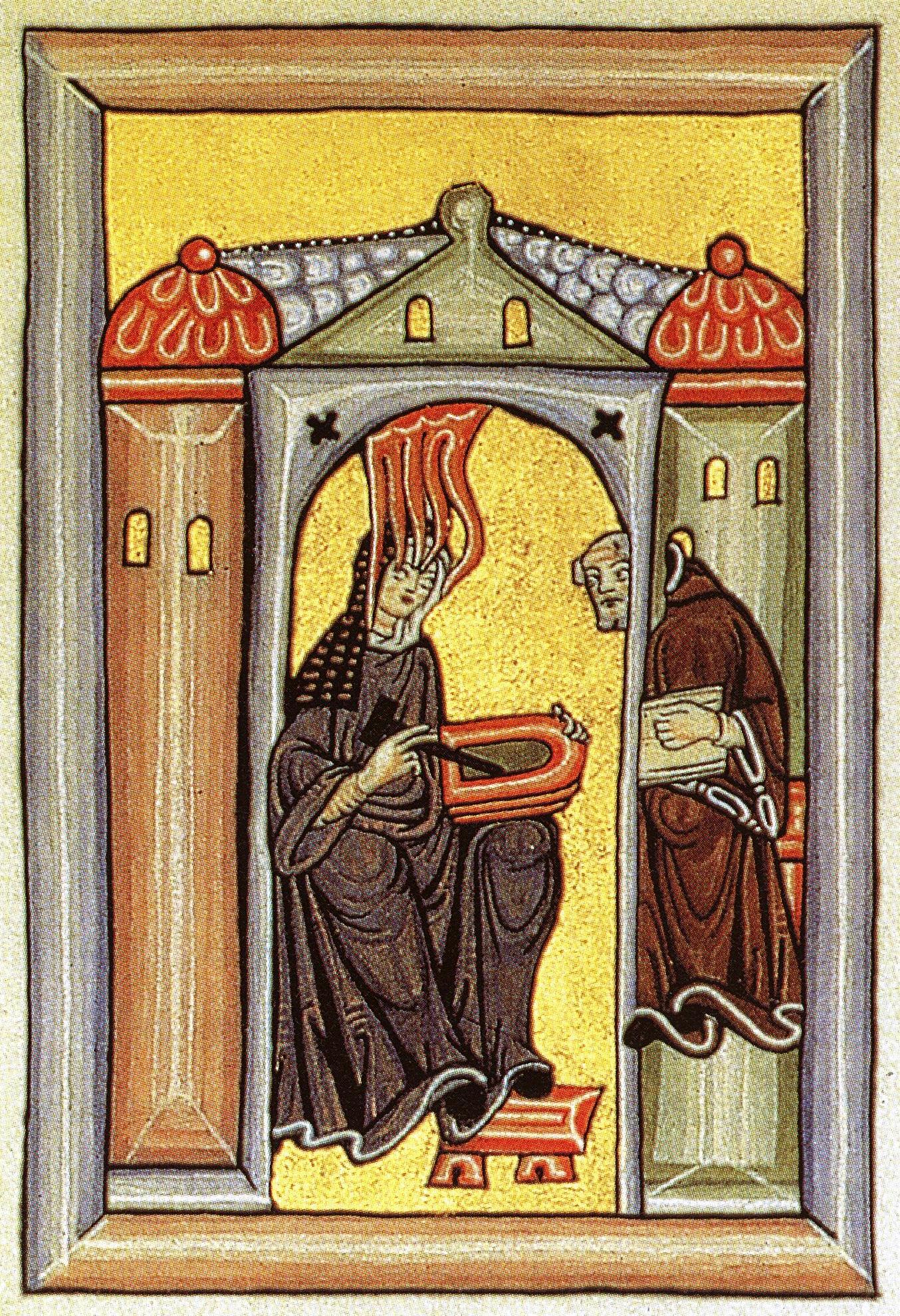
We start with the middle ages⎼ the economy was a strict feudal system, where everyone was born into a specific social class and religion not only satisfied the majority of the lower class, but having a greater impact on women. It was easy for a man to divorce his wife or cheat on her, but the female was not allowed to as her reputation would be affected and legal repercussions would occur. Women were either a stay at home wife, or became nuns, spreading religious views and beliefs. Whitney Chadwick, author of Women, Art, and Society, states “the presence of well endowed convents during the [11th and 12th] centuries encouraged large numbers of women to take up religious lives… there is considerable evidence of women’s participation in [spiritual revival],” (53).
Hildegard of Bingen, Scivias, 1142 
Some females experienced visions from Christ himself and painted what they saw such as Hildegard of Bingen in
. Aside from the religious aspect, females too were writers and clearly artists. An example would be the The Bayeux Tapestry, a long banner with stitching of daily life. Women were not shown in the actual banner, yet it had lots of embroidery revealing the power of the man. “[Scholars don’t know when it was created], but they all agree that it was embroidered by women,” said the Guerrilla Girls’ in Bedside Companion to the History of Western Art. In other words, women had no rights, must obey the man, have no education due to their social status and role in society, but were beginning to reveal their artistic talent. 
Tick tock⎼ Renaissance time. Still, women had no rights and must obey their husband. The most important role was being a housewife and taking care of the kids, cook, help your husband run business when he is away, or if you weren’t married, you lived on your own or joined a church. Women became artists if they were born into it regarding their social class or married a husband who was one and weren’t allowed to join guilds. “...Women were barred from participating in governmental patronage… and they played no part in guild commissions,” (Chadwick 67). You can get become educated now, but it would have to be done through the Church or through an instructor, unfortunately you would need money for that, which few women had.
Artemisia Gentileschi, Judith with Her Maidservant, 1618
During this time period is when the art of sculpting started to grow such as artist Properzia de Rossi who lived on her own. “[Rossi] is the only known Renaissance woman to have sculpted in marble. She began by carving miniatures on cherry stones, but soon went after bigger fruit,” (Guerrilla Girls 31). Her talent caused her great recognition, momentarily, as her reputation became salvaged her work decreased with it. Women artists tried to signify their strength by recreating pieces of art with their own interpretation such as in Artemisia Gentileschi’s
Judith with Her Maidservant, where the two females are drawn with strength and courage versus her father Orazio Gentileschi’s version. They also tried to prove their equality such as in Elisabetta Sirani’s Portia Wounding Her Thigh, where Portia impales a knife on her leg to prove that she is strong like her husband Brutus. As females artistry began to grow, so did paintings of self portraits. These portraits included both genders, male and female, like in Lucias Anguissola’s Portrait of Pietro Maria, 1560.

Elisabeth Sirani, Portia Wounding Her Thigh, 1664

Tick Tock- 18th and 19th century. 18th century art became about domestic scenes and still life art such as painting fruits on table, flowers, etc. Women painted about insects and bugs so clearly that it attributed to future scientific research on these critters such as Anna Maria Sybilla Merian in her books and who was interested in animals and nature. Females roles in society became a little less strict, as women are able to work their way up to become rich, sneak their way into one of the best academies for school (English Royal Academy), or even become teachers to future art students. Still, despite these achievements, women were prostitutes or worked very long hours sewing clothes, doing needlework, etc. Men still were in control, for instance they controlled the wages/earnings women brought home and if you didn’t like a marriage, only choice was to flee. In 19th century, the invention of the camera helped create a new form of art- photography which they could not be rejected from. As animal paintings grew, a symbol was formed- they symbolized freedom/fighting for it. Reason so was due to the increase in fighting for women’s rights, “images of animals frequently symbolized the vices and virtues of women. Constantly exhorted to rise above their ‘animal’ natures, [they] were pursued by animals exemplars,” Chadwick wrote (192). Women also continued to tell stories through their art like in Harriet Powers Pictorial Quilt which had many sewn images of her memories from being a slave.

Harriet Powers, Pictorial Quilt, 1895


In the end, you can see a dramatic change in women and their rights. Being born into this ruling that they must obey, trapped in chains sealed by society and their husbands, caused them to fight for change. From the typical housewife to receiving education, contributing to scientific research, fighting for their rights they never had, women were fed up and it can be revealed through the progression of their art. 


The Bayeux Tapestry's each broken up into different parts as the original is too long.

Since the Renaissance was a very impactful time period, here is more information regarding 
women during this period.

Works Cited
Chadwick, Whitney. Women, Art, and Society. New York, N.Y.: Thames and Hudson,
1990. Print.
The Guerrilla Girls' Bedside Companion to the History of Western Art. New York: 
Penguin, 1998. Print.

Wednesday, February 11, 2015

Who Runs the World? "Men!"

        In the 21st century, women have a greater amount of freedom- women can vote due to ratification of the 19th amendment, becoming deans in institutions, able to create their own artwork without retribution, punishment, etc.- compared to the likes of the middle ages and renaissance. Unfortunately during those time periods, a majority of the females had no freedom, having to deal with typical house work, ex. cleaning, taking care of the children (unless you were born into a rich a family, became a nun, or gain recognition through your art work). One important reason that a females freedom was diminished was due to superiority of the males, having women confine to their orders/commands.
        Feminist and activist Bell Hooks describes in her own words this system known as patriarchy, where men hold the power and females do not. Hooks, in her story The Will to Change: Men, Masculinity, and Love, writes "Patriarchy is a political-social system that insists that males are inherently dominating, superior to everything and everyone deemed weak, especially females...," (18). Hooks, claimed in her story, was born to patriarchy in her household. Being more talented and aggressive than her little brother (traits men should have, not females), she was scolded by her father claiming it is not lady like. Yet patriarchy was not only inherited through the leading male in the house hold, it was also part of religion. Hooks writes, "at church they had learned God created man to rule the world and everything in it and that it was the work of women to help men perform these tasks, to obey, and to always assume a subordinate role [to man]," (18). Religion, being a powerful belief that everyone during these times believed in, helped fuel this system of patriarchy, could have even been what ignited it.  Most common form of patriarchy during these time periods possibly could be the Pope, the king of an empire such as France, Nobilities, husband and/or father. This system is what gives male their dominance and shapes them mentally with authority, which is noticed today amongst many males.
Esther before Ahasuerus, 1622- Artemisia Gentileschi

Female begging to the male to prevent the oncoming violence, source Google Images.

        Aside from describing what patriarchy is, there is another form of male authority which is noticed in the form of art known as the male gaze. This "gaze" is the way male artists view women through their own eyes, often objectifying them to create a perfect, manipulated painting. The female being drawn is not herself as the painter tweaks and edits the painting to satisfy his belief of how the female should actually look. John Berger, in Ways of Seeing, writes "she is not naked as she is. She is naked as the spectator sees her," (50). The spectator is not just the painter himself, but others who observe his fine art. The woman tries to seduce the viewers, having the intention to leave them sexually satisfied. They are subjective to the man, never pleasing themselves, but always giving the man attention in which he desires. "Women are there to feed an appetite," Berger claims, "not to have any of their own, " (55). Within the male gaze, there is a distinction by which the women are drawn, being nude versus being naked. When you are naked, you are vulnerable to whom ever looks at you- bare skin. But when your are nude, it is basically a disguise of a naked person, only being there to represent a body and disconnecting from yourself. "To be naked is to be oneself. To be nude is to been naked by others and yet not recognized for oneself," Berger writes (54). The only person being recognized is the painter and the observers. It is this sense of satisfaction and sexual relief which males receive when painting females in their own eyes, degrading women to help obtain this sensation.
        Whitney Chadwick, author of  Women, Art, and Society, writes "... the gaze became a metaphor for the worldliness and virility associated with public man and women became its object," (74), resembling a form of patriarchy a brief definition of the male gaze. When reading both texts separately (not analyzing both), I could not find the relation between Patriarchy and art. After, I was able to notice a form of it by analyzing the male gaze in which men have this control over women, their art, and they have no choice but satisfy his wants. You can also see forms of the male gaze not just in female magazines, but males too such as Sports Illustrated, having these models pose in a specific manner grasping the observers attention.

Male Gaze- Sports Illustrated 2007

The Birth of Venus- Sandro Botticelli, 1486


Works Cited

Chadwick, Whitney. Women, Art, and Society. New York, N.Y.: Thames and Hudson, 1990. Print.

Hooks, Bell. The Will to Change: Men, Masculinity, and Love. New York: Atria, 2004. Print.

Berger, John. Ways of Seeing. London: British Broadcasting :, 1973. Print.


Monday, January 26, 2015

The Art of the Human Body

Taught in the well known institution Rutgers University, as well as revealing her creativity through forms of film, photography, and painting, contemporary artist Carolee Schneemann's general focus in her work are erotic, gender, or on the human body. While currently working in art media, she originally started her career by being a painter. While her first well known piece of art is not being a painting, it is actually a photo of herself surrounded with various material and life, known as Eye Body: 36 Transformative Actions. Through the course of her career, she adopted the idea of feminism and incorporated it in her work, such as her erotic film known as Fuse, where the male and female are equal, not one higher than the other. She incorporates herself in her work to distinguish the creativity women have in art that seems to be unnoticed. 
1964: Meat Joy
1975: Inner Scroll